

Ruling Georgian Dream party criticises Venice Commission's conclusion on transparency law
Politics
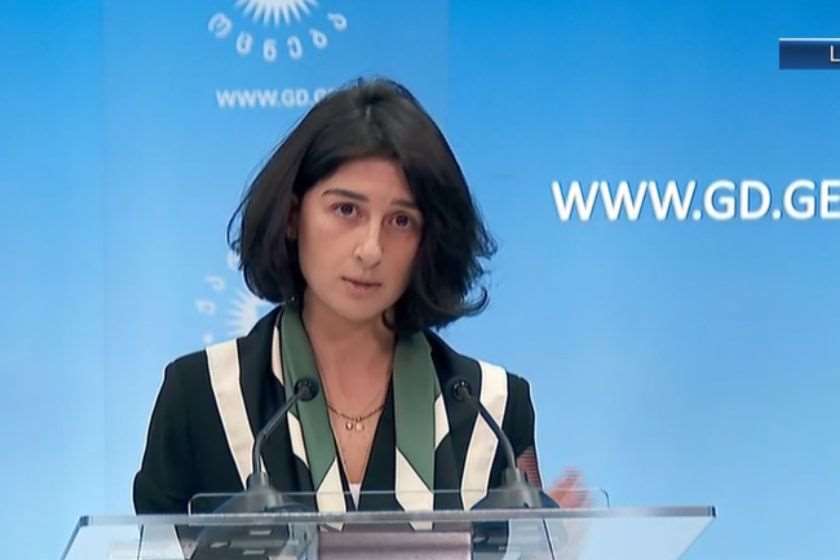
Salome Kurasbediani
Photo: Imedi TV
The ruling Georgian Dream party on Tuesday responded to the Venice Commission's critical opinion on the domestic law on transparency of foreign Influence, asserting that the conclusion lacks substantiated legal arguments and contains biassed political assessments.
Salome Kurasbediani, a member of the parliamentary majority, addressed the media at the Georgian Dream party press briefing, criticising the Venice Commission's recent conclusion on the law on transparency of foreign influence.
“We would like to respond to the conclusion of the Venice Commission regarding the law of Georgia on transparency of foreign influence, on which the radical opposition and related NGOs have high hopes. The conclusion of the Venice Commission confirmed once again that there are no legal or other arguments against the Georgian law on transparency”, Kurasbediani said.
Kurasbediani argued that the conclusion was filled with unsubstantiated legal arguments, factual inaccuracies, and political bias, thus failing to provide valid reasons against the law.
“In the conclusion of the Venice Commission, we find a lot of unsubstantiated and contradictory legal arguments, as well as a number of gross distortions of facts, which further encourages the radicalisation of specific groups. It is therefore disappointing that the platform of the Venice Commission has been used to make biassed political judgments instead of professional judgement, which again and again damages the reputation of the Venice Commission”, she noted.
Kurasbediani noted that the Commission’s conclusion stated that the final text of the transparency law with the additional changes included in it had not been made public immediately.
“When voicing this information, the Venice Commission relies on one of the Georgian internet articles. In fact, we included the mentioned clarifications in the draft law in its 2nd reading during the discussion at a plenary session of the Parliament, which was announced verbatim at a plenary session and was broadcast live. Accordingly, these clarifications were immediately published on the website of the Parliament of Georgia even before the adoption of the law”, Kurasbediani noted.
“At the same time, the Venice Commission appeals that the [transparency] law seems to have been adopted in a short period of time, and it seems that the stakeholders did not have the opportunity to participate in its discussion. In fact, let us remind you that the discussion of the draft law was carried out in a standard procedure (without any acceleration) for several weeks, during many hours of committee and plenary sessions, where the radical opposition was fully represented. NGOs also actively participated in the discussion”, she continued.
The Venice Commission's portrayal of the protests as entirely peaceful was challenged by Kurasbediani, who pointed to numerous incidents of violence against law enforcement and property damage during the protests.
“The Venice Commission notes that the current legislation of Georgia seems to provide for the obligation to register the finances of NGOs and submit reports. To confirm this, it refers to the Civil Code of Georgia, the Tax Code of Georgia and other separate normative acts. In fact, all the current norms that the Venice Commission appeals to in its conclusion cannot ensure the obligation of the NGO sector to fill in the financial declaration, nor the transparency of their finances. Therefore, the Commission's indication that the financial part of grants received by NGOs is transparent is not true!”, she said.
The Commission's brief comparison of the Georgian law with similar laws in Russia, Hungary, and Kyrgyzstan was labelled manipulative and lacking in legal reasoning by Kurasbediani.
Kurasbediani cited the European Court of Justice's decision, which supports the transparency of NGO finances, contradicting the Venice Commission's stance that NGOs should not be required to be transparent.
The European Commission for Democracy (Venice Commission) on Tuesday issued an urgent opinion urging the repeal of Georgia's Law on Transparency of Foreign Influence, citing significant incompatibility with international human rights standards.


